
Quality center
How to know which peptide supplier to trust
You cannot tell a real vial from a fake one by looking at it. You can tell a real certificate from a decorative one in about five minutes. Below is one of ours, exactly as the laboratory issued it, with every part that matters pointed at. Then the same checklist to run on anyone, including us.
Not sure where to start
How familiar are you with peptides?
No wrong answer. It just changes where we start you.
Three taps, then your details, and pricing opens on all 36 compounds. No password.
- 132
- Certificates published
- 3
- Independent laboratories
- 0
- Behind a paywall
The short version
Three questions, in this order
Everything below is these three questions asked of a real document. If a supplier's paperwork answers all three, you are most of the way there. If it cannot answer the first, nothing else on the page matters.
Is it about the vial in your hand?
A certificate describes one lot, tested once, on a date. The lot number on the document has to match the lot printed on the vial, and the date has to make sense. A certificate with no lot, or one lot that ships for months, describes a product line, not your material.
Who says so?
The laboratory should be named, findable, and independent of the seller. An address, a phone number, a website, and ideally an accreditation you can look up in a public directory. Testing done by the seller and called third party is the most common trick in this category.
Can you see the evidence, or only the number?
A purity figure typed into a table can be typed by anyone. A chromatogram with labeled axes, a named peak, the small peaks left in, an uncertainty on the result, and a method beside every pass is evidence. So is a lab stating what it did not test.
Worked example
One of our certificates, with the arrows on
Our AOD-9604 5 mg lot 1201AOR, exactly as Vanguard Laboratory issued it. Nothing is retouched. Seven arrows, each on one number or word a buyer can act on. Hover or tap a number to read why it matters.
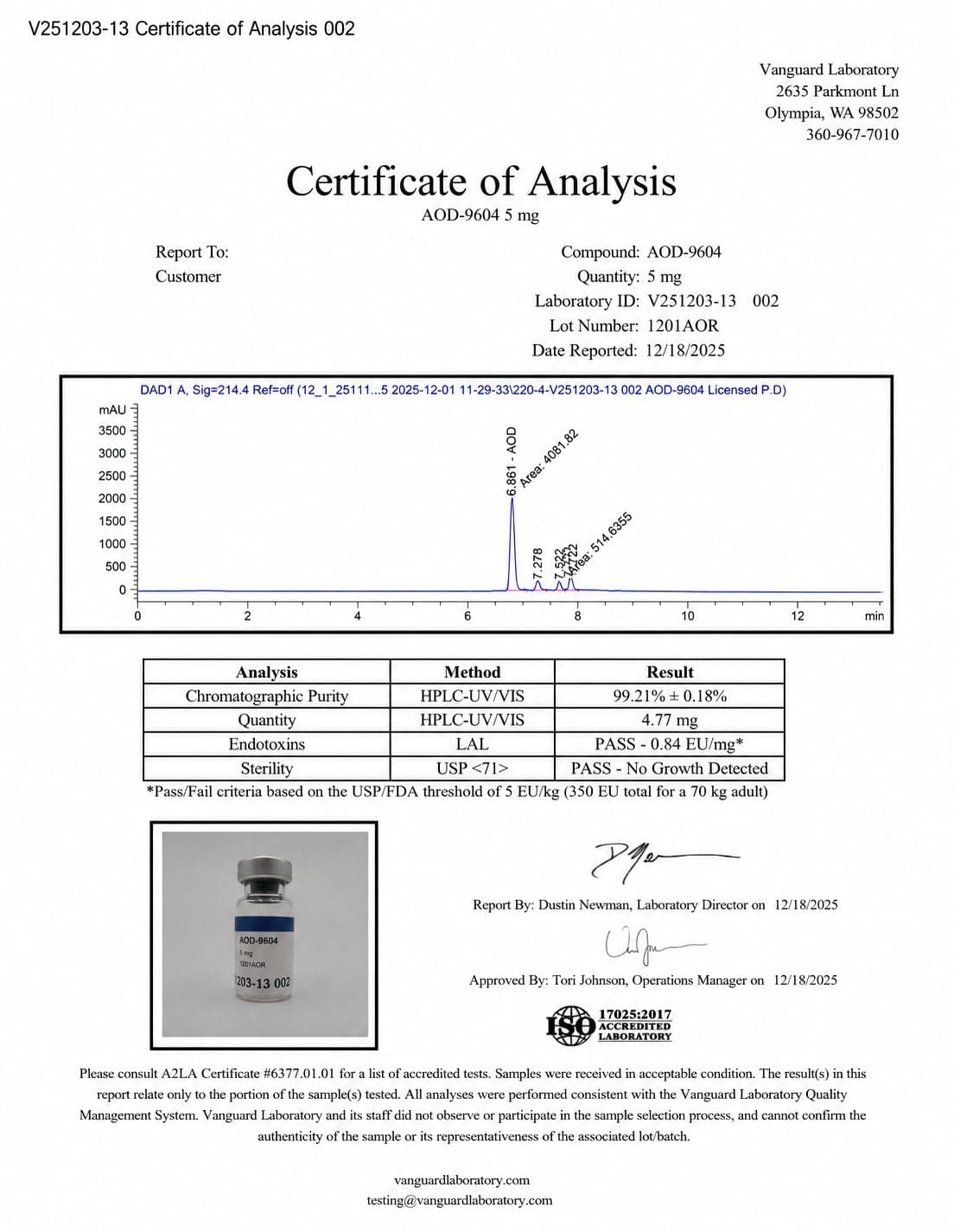
- 1The lab is namedVanguard Laboratory, with a street address and a phone number under it. It is listed in the A2LA accreditation directory, an independent register, not the lab's own site. No lab named means no test happened.Vanguard in the A2LA directory
- 2The lot number matches your vial1201AOR is printed on the label of the vial in the photo lower down. If the lot on the certificate is not the lot in your hand, the certificate is about something else.
- 3The main peak is namedThe peak at 6.861 minutes is labeled AOD. This trace is the evidence the purity number is calculated from, attached rather than described.
- 4The impurities are shownThree small peaks, each integrated. That is the other 0.79 percent. One perfect peak and nothing else is the pattern of a document assembled rather than measured.
- 5Purity carries an uncertainty99.21 percent plus or minus 0.18. Real instruments have error and honest labs print it. A round 99 percent across a whole catalogue is a specification, not a result.
- 6The fill is measuredThe label says 5 mg. The lab found 4.77 mg. That is the number a seller would round up if the seller controlled the document.
- 7The accreditation can be looked upISO/IEC 17025, A2LA certificate 6377.01, a public directory entry valid through September 2027. A logo you cannot verify is decoration.Open the A2LA directory entry
Second example
A blend has to prove both halves
Blends are where thin paperwork hides best, because one peak and one number can look complete. Our BPC-157 / TB-500 certificate from the same laboratory, with the four things a blend has to show.
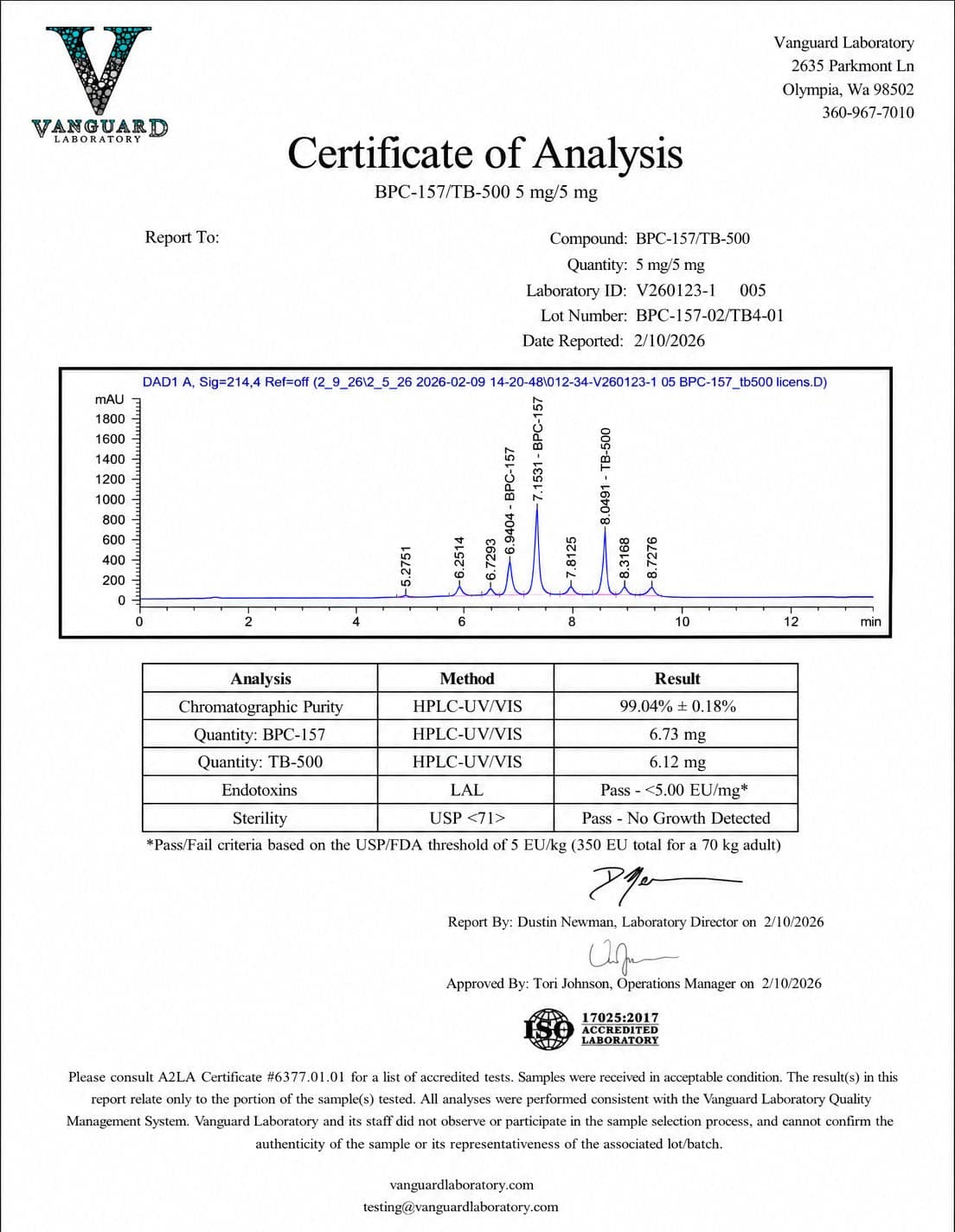
- 1Two lots, one documentBPC-157-02/TB4-01 names the source lot of each half. A blend sold under one lot number cannot be traced to either component.
- 2BPC-157 as its own peakLabeled by name at 7.1531 minutes. A blend certificate with one unnamed peak has tested one thing, or has not said which.
- 3TB-500 as its own peakResolved separately at 8.0491 minutes. Two compounds, two peaks, both visible on the same trace.
- 4A quantity for each half6.73 mg of BPC-157, and 6.12 mg of TB-500 on the row below, against a 5 mg / 5 mg label. One quantity on a blend certificate leaves you asking which half it describes.
Now run it on everyone else
The same checks, pointed at any supplier
Each row names where the item sits on our certificate above and the failure that should end the conversation somewhere else. Print it, or keep this page open while you read theirs.
| What to check | On ours | Walk away if |
|---|---|---|
| Lot number on the certificate matches the vialArrow 2 | Arrow 2 | No lot number, or the same lot number on orders placed months apart |
| The lab is named, findable, and not the sellerArrows 1 and 7 | Arrows 1 and 7 | No laboratory named, or the seller tests its own product and calls it third party |
| The chromatogram is attached, full length, peaks labeledArrows 3 and 4 | Arrows 3 and 4 | A purity number with no trace, or a trace cropped at either end |
| A method is stated beside every resultThe Method column of the results table | The Method column of the results table | A pass with no method, or the phrase pharmaceutical grade doing the work of a test |
| The number carries an uncertainty, or at least varies between lotsArrow 5, and the 98.00 percent lot in the library | Arrow 5, and the 98.00 percent lot in the library | Every product in the catalogue at the same round figure |
| Signed and dated by peopleThe two signatures at the foot of the certificate | The two signatures at the foot of the certificate | Unsigned, undated, or dated before the lot existed |
| The limits are stated on the documentThe small print under the signatures | The small print under the signatures | The certificate reads like an advertisement |
Where our own record is imperfect
Said here first, because you would find it anyway
A page that teaches you to check suppliers and then hides its own gaps would fail its own test. These are ours, read off the same library the arrows above come from.
- Not every lot carries every test. Our current lots are tested by 3 laboratories, and each runs a different panel. Vanguard reports purity, quantity, endotoxin and sterility, but no mass spectrometry identity check. Freedom Diagnostics reports purity and LC-MS identity, but no endotoxin or sterility. No lot in the library yet carries both panels from one lab, and we would rather say that than imply it. Today 12 of 24 current lots carry a mass spectrometry identity result and 9 carry a sterility test.
- The ISO 17025 accreditation mark shown at arrow 7 appears on 9 of 24 current lots. The rest were tested by laboratories without it, and the product page for each compound names which lab tested it.
- Some certificates identify the sample by the lab's own submission number rather than our batch code, and a few carry a vial description like Blue Cap in the lot field. On those, the per sample identifier is the laboratory ID suffix. If your vial does not match a report at a glance, send us the label and we pull the right record.
- There are 2 current certificates that report no purity percentage at all, one because the lab ran identity and quantity only, one because it ran endotoxin and sterility only. Those product pages print nothing for purity rather than borrowing a number.
- Our lowest published purity is 98.00% ± 0.18%. It is on the product page and in the library, beside the document it came from.
- A certificate cannot tell you how the vial was stored after it left our cold room, and neither can we. Chain of custody ends where shipping begins, which is why the quality page lists it among the things no certificate can do.
Five minutes, no account
Three checks you can run on us right now
- 01
Look the lab up
Vanguard Laboratory, the lab behind both certificates above, is listed in the A2LA accreditation directory under certificate 6377.01, as Olympic Analytical LLC doing business as Vanguard Laboratory. A2LA is the accreditation body, not the lab, so the entry is not something the lab wrote about itself. Ask any other supplier for the same entry for their lab.
Vanguard in the A2LA directory - 02
Open any certificate
Every current lot is published full size, as the lab issued it, with no account and no request form. Pick a compound, open the document, and run the checklist above on it. When a vial arrives, match the lot on the label to the report.
Open the COA library - 03
Run it on the next supplier
Take the checklist above to whoever you are comparing us against. Ask for the certificate for the lot that would ship, then look for the lab, the lot number, the trace, and the method. A template cannot answer those. A real test can.
Back to the checklist
Want to see pricing? Just your name and email.
About 20 seconds. Pricing and availability open on every compound and stay open. No password, unsubscribe any time. Prefer a guided start? The 1-minute quiz builds you a reading list too.
For research use only. Not for human consumption. Not FDA approved.