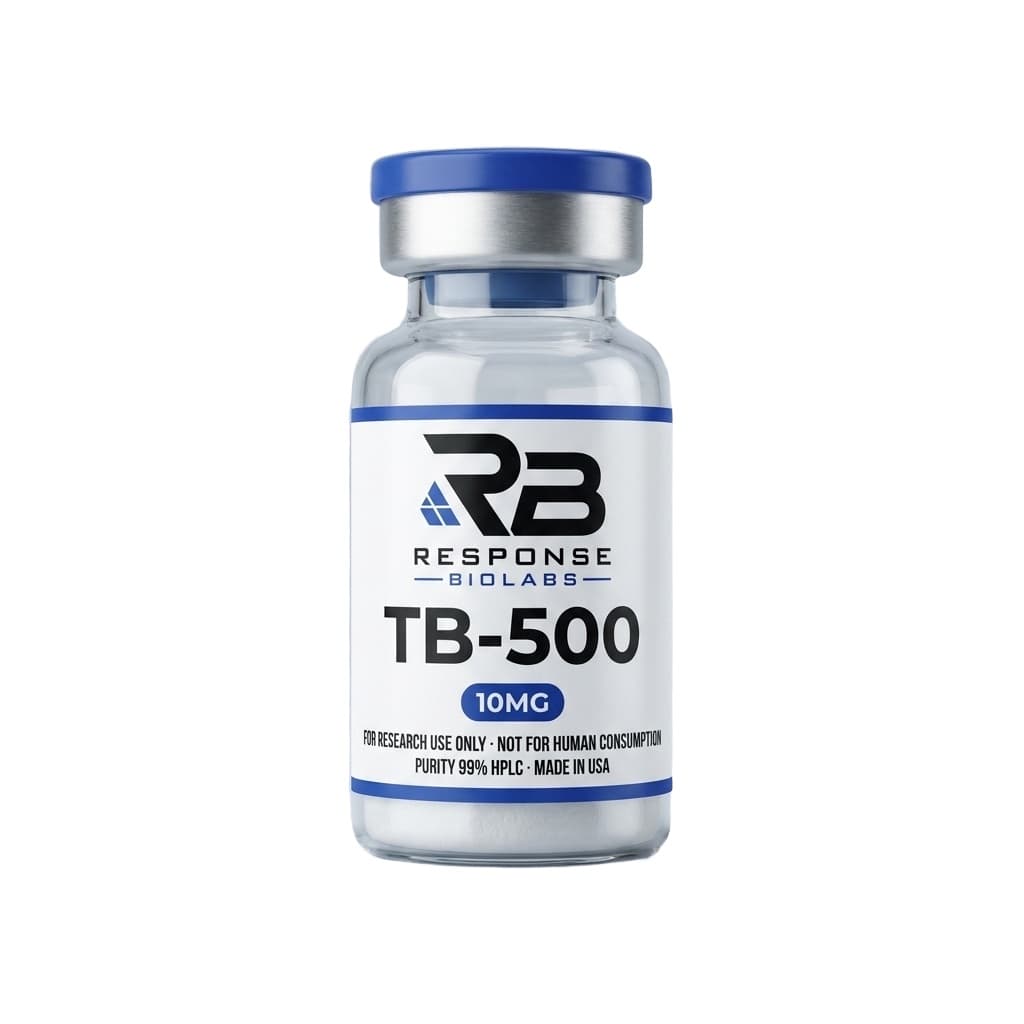
TB-500
10mg vial
Three quick questions about your research opens pricing and live availability, free and no password.
TB-500 (Thymosin Beta-4) is a naturally occurring peptide present in virtually all human and animal cells. Investigated in preclinical research for its interactions with actin polymerization and cytoskeletal dynamics.
Specification
- CAS No.
- 77591-33-4
- Molecular Formula
- C212H350N56O78S
- Molecular Weight
- 4963 g/mol
- Appearance
- White lyophilized powder
- Storage
- Refrigerate (2-8 deg C)
- Purity
- >=99%
Current lot
99.555%
Purity, measured by HPLC-UV
- Lot
- TB526-10-004
- Laboratory
- Freedom Diagnostics
- Reported
- 25 February 2026
- Net peptide
- 11.00 mg
- Identity confirmed by mass spectrometry
Research library
Read the full TB-500 research summary
Chemistry, mechanisms under investigation, and the state of the published evidence.
For research use only. Not for human consumption. Not FDA approved.
What TB-500 is
TB-500 is synthetic thymosin beta-4, a forty-three-residue actin-sequestering peptide studied in animal models of tissue repair and cell migration.
Sequence SDKPDMAEIEKFDKSKLKKTETQEKNPLPSKETIEQEKQAGES (N-terminally acetylated in the native protein)
Mechanisms under investigation
Proposed pathways from the published literature. Not established clinical effects.
- 01Sequesters monomeric G-actin in a one-to-one complex through the central LKKTETQ actin-binding region, maintaining the unpolymerized actin reserve pool.
- 02Regulates the availability of actin subunits for filament assembly during lamellipodial extension and cytoskeletal reorganization.
- 03Associated with increased endothelial cell migration and vessel formation in angiogenesis assays in animal and in vitro models.
- 04Reported downregulation of nuclear factor kappa B signaling with reduced inflammatory cytokine output in corneal and dermal injury models.
- 05Described anti-fibrotic association involving reduced myofibroblast transition and altered collagen deposition in animal models.
- 06Reported interactions with integrin-linked kinase signaling and with the DNA repair-associated protein Ku80.
Where the evidence stands
The parent protein thymosin beta-4 is genuinely well characterized biochemically, and topical ophthalmic formulations of it have been evaluated in registered human trials. The injectable research peptide sold as TB-500 has no completed human clinical trial of its own, and the repair literature is overwhelmingly rodent and rabbit work.
What is established: the identity, structure, abundance, and actin-sequestering function of thymosin beta-4 are well characterized and independently confirmed across many laboratories. Its intrinsic disorder and its binding mode with G-actin are described in structural detail. This part of the literature is ordinary, solid cell biology.
What has limited human data: topical ophthalmic thymosin beta-4 has been evaluated in registered randomized human trials, including a published phase 2 trial in severe dry eye. This is a meaningful distinction from most compounds in this library, which have no human trial exposure at all. However, those trials studied a topical eye drop in an ocular indication. They provide no basis for conclusions about systemic exposure, about any other tissue, or about the injectable research peptide.
Common questions
What is TB-500 studied for?
TB-500 is synthetic thymosin beta-4, a forty-three-residue actin-sequestering peptide studied in animal models of tissue repair and cell migration.
Does TB-500 come with a certificate of analysis?
Yes. 11 third party certificates for TB-500 are published on this site, covering endotoxin, purity and sterility. Each one is the report as the testing laboratory issued it, not a retyped summary, and the most recent lot is 10mg · 3/12/2026. Match the batch on your vial to the batch on the report.
What is the CAS number for TB-500?
77591-33-4. It is printed in the specification table on this page so it can be checked against your own records before ordering.
How should TB-500 be stored?
Refrigerate (2-8 deg C) Lyophilized powder is the stable form; once reconstituted, a solution is far more fragile and should be aliquoted rather than repeatedly frozen and thawed.
What purity is TB-500?
>=99% by HPLC. The released figure for any given lot is on that lot's certificate rather than taken from this page, because purity is a property of a batch and not of a product line.
Is TB-500 intended for human use?
No. This is sold for laboratory research use only. It is not a drug, not a supplement, and not approved by the FDA for human or veterinary use. We do not provide dosing, administration, or protocol guidance, by phone, by email, or through the assistant on this site.
Is TB-500 the same molecule as thymosin beta-4?
Not always. TB-500 is a research-market name that vendors apply to full-length synthetic thymosin beta-4 and, in some cases, to a shorter fragment containing the LKKTETQ actin-binding region. The two differ in mass, in reported activity profile, and in how published results apply. Confirm identity against the mass spectrometry data for the specific lot.
Does TB-500 have any human clinical trial data?
Topical ophthalmic formulations of synthetic thymosin beta-4 have been evaluated in registered randomized human trials, including a published phase 2 dry eye trial. There is no completed human clinical trial of the injectable research peptide for musculoskeletal or systemic applications, and the ophthalmic results do not transfer to other routes or tissues.
Why does an intrinsically disordered peptide matter for handling?
Because there is no tertiary structure to denature, lyophilization and reconstitution do not require a refolding step, and mild temperature excursions do not destroy a fold that does not exist. Degradation instead proceeds by backbone hydrolysis in solution and by oxidation of the single methionine residue, so the controls that matter are time in solution, temperature, and air exposure.
How is TB-500 different from BPC-157 as a research subject?
TB-500 is a naturally occurring forty-three residue protein with a confirmed intracellular biochemical function, studied for additional extracellular activities. BPC-157 is a fifteen residue synthetic fragment with no confirmed endogenous role, studied primarily through angiogenic receptor and focal adhesion signaling. TB-500 has a firmer biochemical foundation; both have animal-dominated repair literatures.
What does the LKKTETQ motif do?
It is the central heptapeptide region most often identified as the actin-binding domain of thymosin beta-4. Several published studies use this fragment or extended versions of it instead of the full protein, which is one reason results reported for TB-500 in the literature are not always directly comparable.
Is TB-500 prohibited in sport?
Yes. TB-500 appears on the World Anti-Doping Agency Prohibited List under the category covering peptide hormones, growth factors, and related substances.
References
Every citation links to the paper it names on PubMed.
- 01Safer D, Elzinga M, Nachmias VT (1991). Thymosin beta 4 and Fx, an actin-sequestering peptide, are indistinguishable. Journal of Biological Chemistry. PMID 1999398
- 02Goldstein AL, Hannappel E, Kleinman HK (2005). Thymosin beta4: actin-sequestering protein moonlights to repair injured tissues. Trends in Molecular Medicine. PMID 16099219
- 03Bock-Marquette I, Saxena A, White MD, DiMaio JM, Srivastava D (2004). Thymosin beta4 activates integrin-linked kinase and promotes cardiac cell migration, survival and cardiac repair. Nature. PMID 15565145
- 04Malinda KM, Sidhu GS, Mani H, et al. (1999). Thymosin beta4 accelerates wound healing. Journal of Investigative Dermatology. PMID 10469335
- 05Sosne G, Qiu P, Christopherson PL, Wheater MK (2007). Thymosin beta 4 suppression of corneal NFkappaB: a potential anti-inflammatory pathway. Experimental Eye Research. PMID 17254567
- 06Crockford D, Turjman N, Allan C, Angel J (2010). Thymosin beta4: structure, function, and biological properties supporting current and future clinical applications. Annals of the New York Academy of Sciences. PMID 20536467
- 07Sosne G, Dunn SP, Kim C (2015). Thymosin beta4 significantly improves signs and symptoms of severe dry eye in a phase 2 randomized trial. Cornea. PMID 25826322
- 08Philp D, Kleinman HK (2010). Animal studies with thymosin beta 4, a multifunctional tissue repair and regeneration peptide. Annals of the New York Academy of Sciences. PMID 20536453
Related compounds