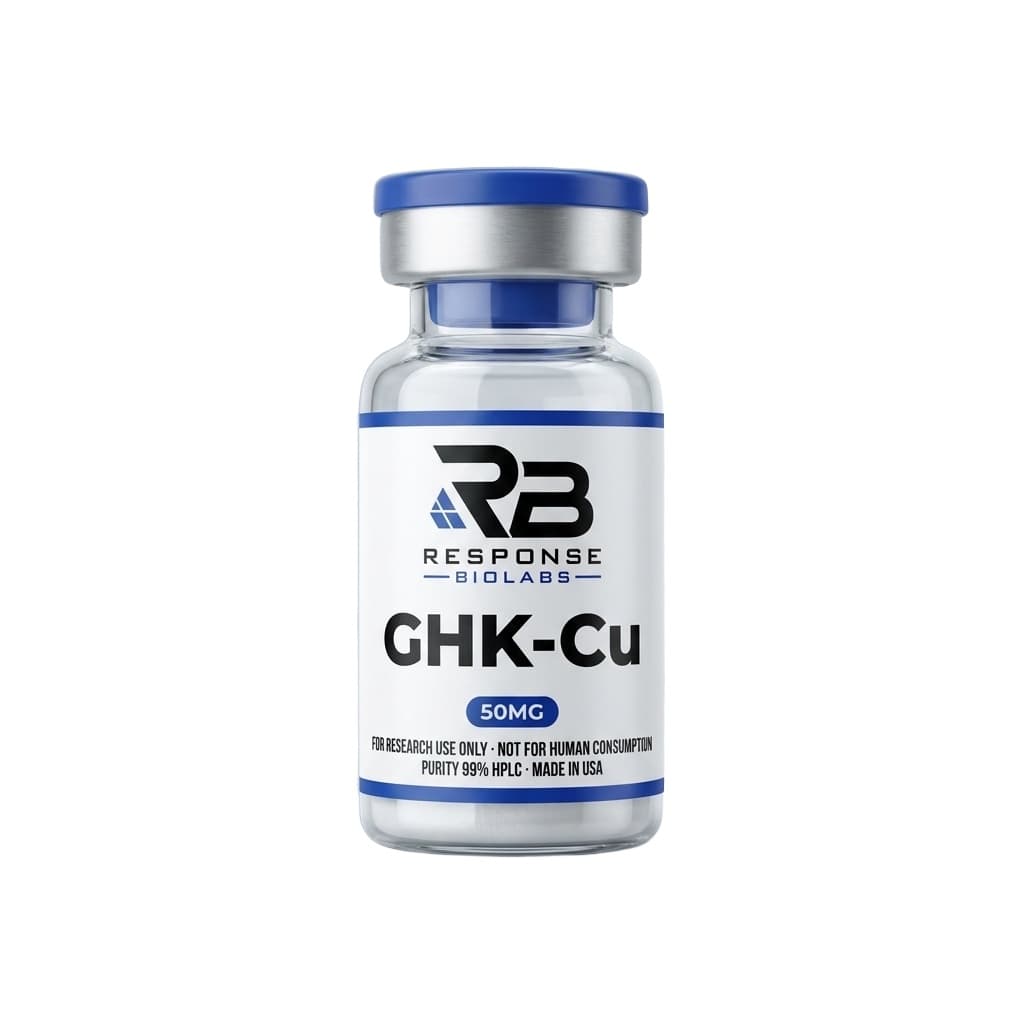
GHK-Cu
50mg vial
Three quick questions about your research opens pricing and live availability, free and no password.
GHK-Cu (Copper Peptide) is a naturally occurring copper complex with studied in preclinical research for its interactions with cellular signaling pathways and extracellular matrix proteins.
Specification
- CAS No.
- 49557-75-7
- Molecular Formula
- C14H24N6O4
- Molecular Weight
- 340.39 g/mol
- Appearance
- Blue lyophilized powder
- Storage
- Refrigerate (2-8 deg C)
- Purity
- >=99%
Current lot
99.923%
Purity, measured by HPLC-UV
- Lot
- GHK28-50-006
- Laboratory
- Freedom Diagnostics
- Reported
- 31 March 2026
- Net peptide
- 58.23 mg
- Identity confirmed by mass spectrometry
- Endotoxin: Pass, both replicates
Research library
Read the full GHK-Cu research summary
Chemistry, mechanisms under investigation, and the state of the published evidence.
For research use only. Not for human consumption. Not FDA approved.
What GHK-Cu is
GHK-Cu is a naturally occurring copper-binding tripeptide studied in cell culture and animal models for its interactions with extracellular matrix synthesis.
Sequence Gly-His-Lys (GHK), complexed with copper(II)
Mechanisms under investigation
Proposed pathways from the published literature. Not established clinical effects.
- 01Binds copper(II) through the amino terminus, the histidine imidazole nitrogen, and a deprotonated backbone amide nitrogen in a square planar geometry related to the albumin copper binding motif.
- 02Holds copper at an intermediate affinity that permits exchange with albumin and cellular copper-handling proteins, functioning as a carrier rather than a chelator.
- 03Supplies copper to cuproenzymes including lysyl oxidase, which crosslinks collagen and elastin by oxidatively deaminating lysine residues to allysine.
- 04Reported stimulation of collagen, elastin, glycosaminoglycan, and decorin synthesis in cultured dermal fibroblasts across multiple independent laboratories.
- 05Reported modulation of the matrix metalloproteinase and tissue inhibitor balance, consistent with altered remodeling rather than unidirectional matrix accumulation.
- 06Reported broad shifts in gene expression in cultured cells across matrix remodeling, DNA repair, antioxidant, and inflammatory signaling categories.
Where the evidence stands
The copper coordination chemistry and the fibroblast culture findings are well documented and independently reproduced, and small human studies exist for topical cosmetic formulations. The broader claims about tissue remodeling come from cell culture and rodent models, and a substantial share of the review literature is authored by the compound's original discoverer.
What is established: the coordination chemistry is solid and independently verified. GHK binds copper(II) in a defined geometry with a measurable affinity, and the copper dependence of lysyl oxidase and the other cuproenzymes named above is textbook biochemistry. The fibroblast culture findings on collagen and matrix protein synthesis have been reproduced by laboratories independent of the original discoverer, which is a meaningful strength relative to several other compounds in this category.
What has limited human data: small human studies exist for topical cosmetic formulations containing the copper peptide, generally measuring skin appearance and related endpoints. These studies are typically small, of short duration, frequently industry-sponsored, and conducted on formulated topical products rather than on the raw compound. They establish that topical formulations have been evaluated in people. They do not establish systemic effects, do not address any other route, and should not be cited as clinical evidence in the sense that term carries in medicine.
Common questions
What is GHK-Cu studied for?
GHK-Cu is a naturally occurring copper-binding tripeptide studied in cell culture and animal models for its interactions with extracellular matrix synthesis.
Does GHK-Cu come with a certificate of analysis?
Yes. 11 third party certificates for GHK-Cu are published on this site, covering endotoxin, purity and sterility. Each one is the report as the testing laboratory issued it, not a retyped summary, and the most recent lot is 50mg · 4/1/2026. Match the batch on your vial to the batch on the report.
What is the CAS number for GHK-Cu?
49557-75-7. It is printed in the specification table on this page so it can be checked against your own records before ordering.
How should GHK-Cu be stored?
Refrigerate (2-8 deg C) Lyophilized powder is the stable form; once reconstituted, a solution is far more fragile and should be aliquoted rather than repeatedly frozen and thawed.
What purity is GHK-Cu?
>=99% by HPLC. The released figure for any given lot is on that lot's certificate rather than taken from this page, because purity is a property of a batch and not of a product line.
Is GHK-Cu intended for human use?
No. This is sold for laboratory research use only. It is not a drug, not a supplement, and not approved by the FDA for human or veterinary use. We do not provide dosing, administration, or protocol guidance, by phone, by email, or through the assistant on this site.
What is the difference between GHK and GHK-Cu?
GHK is the free tripeptide glycyl-histidyl-lysine, molecular weight approximately 340.4 g/mol, CAS 49557-75-7. GHK-Cu is that peptide complexed with copper(II), molecular weight approximately 403.9 g/mol, CAS 89030-95-5. Nearly all of the biological literature concerns the copper complex, and the blue color is the visible signature of the bound metal.
Why does the copper matter mechanistically?
Because copper is a required cofactor for a specific set of enzymes, most relevantly lysyl oxidase, which forms the covalent crosslinks in collagen and elastin. Free copper is redox active and is not permitted to circulate unbound, so a carrier that can deliver it without releasing it into solution occupies a functionally distinct role from either free copper or a chelator.
Is there human clinical data on GHK-Cu?
There are small human studies on topical cosmetic formulations containing the copper peptide, typically short, small, and frequently industry-sponsored. There is no controlled human clinical trial of injectable or systemic GHK-Cu, no published human pharmacokinetic data for that route, and no long-term human safety data.
Which buffers are incompatible with GHK-Cu?
Any buffer with significant chelating capacity. EDTA-containing buffers will strip copper from the complex, and concentrated phosphate buffers can interfere with copper coordination. Where the intact complex is the experimental subject, buffer chelating capacity should be checked before use, since a stripped complex is a different material than the one intended.
What controls should a GHK-Cu experiment include?
Copper alone and the free peptide alone, at matched concentrations. Copper is a redox-active metal and introducing it into any system introduces copper load as a variable. Without those controls it is not possible to distinguish a result attributable to the complex from a result attributable to copper or to the peptide independently.
Why is the color of the material important?
The blue color arises from the d-d electronic transition of copper(II) bound in the complex, centered near 620 nanometers. White material is the free peptide or a complex that has lost its metal. A solution that fades has changed its copper coordination state, and green or brown discoloration indicates oxidation state change or degradation. Color is the fastest available identity and stability check.
References
Every citation links to the paper it names on PubMed.
- 01Pickart L, Thaler MM (1973). Tripeptide in human serum which prolongs survival of normal liver cells and stimulates growth in neoplastic liver. Nature New Biology. PMID 4349963
- 02Maquart FX, Pickart L, Laurent M, et al. (1988). Stimulation of collagen synthesis in fibroblast cultures by the tripeptide-copper complex glycyl-L-histidyl-L-lysine-Cu2+. FEBS Letters. PMID 3169264
- 03Simeon A, Emonard H, Hornebeck W, Maquart FX (2000). The tripeptide-copper complex glycyl-L-histidyl-L-lysine-Cu2+ stimulates matrix metalloproteinase-2 expression by fibroblast cultures. Life Sciences. PMID 11045606
- 04Kagan HM, Li W (2003). Lysyl oxidase: properties, specificity, and biological roles inside and outside of the cell. Journal of Cellular Biochemistry. PMID 12577300
- 05Campbell JD, McDonough JE, Zeskind JE, et al. (2012). A gene expression signature of emphysema-related lung destruction and its reversal by the tripeptide GHK. Genome Medicine. PMID 22937864
- 06Pickart L, Vasquez-Soltero JM, Margolina A (2015). GHK peptide as a natural modulator of multiple cellular pathways in skin regeneration. BioMed Research International. PMID 26236730
- 07Pickart L, Margolina A (2018). Regenerative and protective actions of the GHK-Cu peptide in the light of the new gene data. International Journal of Molecular Sciences. PMID 29986520
Related compounds