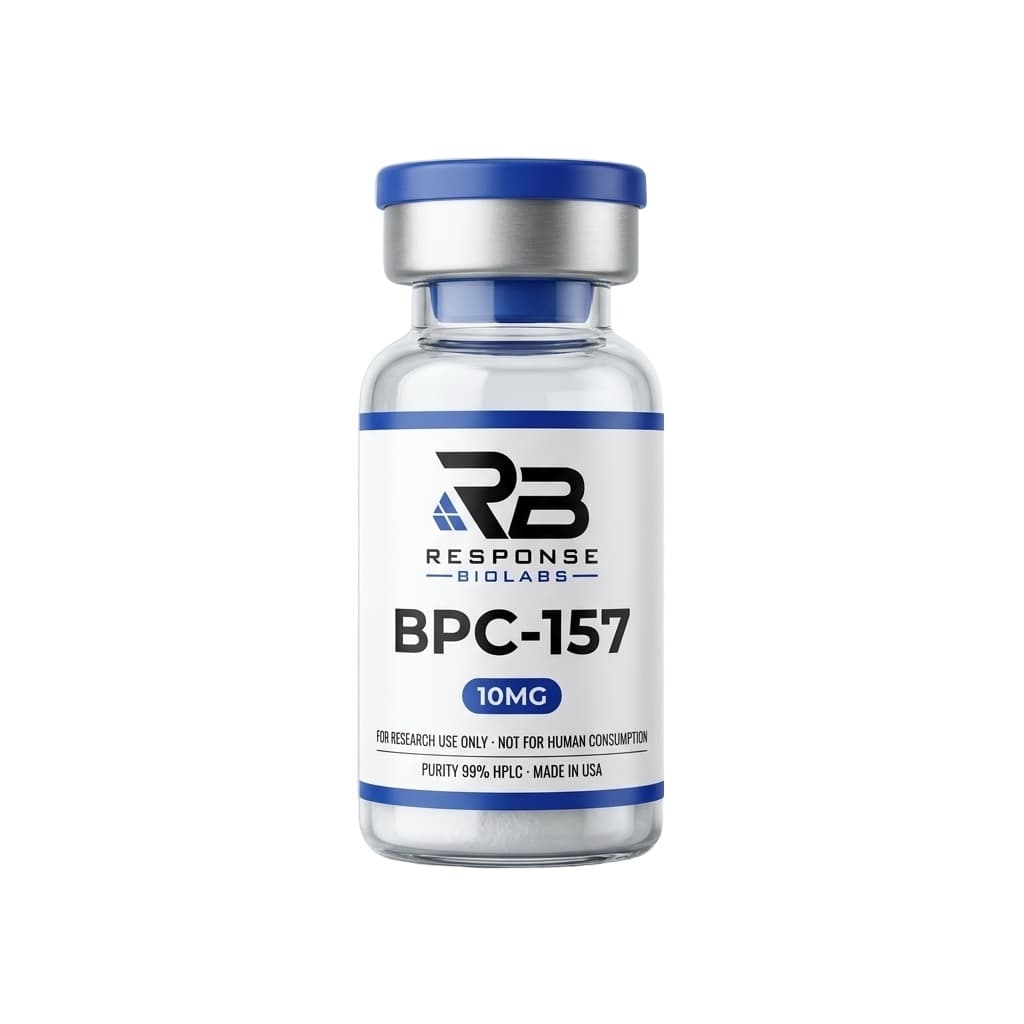
BPC-157
10mg vial
Three quick questions about your research opens pricing and live availability, free and no password.
Body Protective Compound 157 (BPC-157) is a synthetic pentadecapeptide under investigation in preclinical research for its molecular signaling properties.
Specification
- CAS No.
- 137525-51-0
- Molecular Formula
- C62H98N16O22
- Molecular Weight
- 1419.54 g/mol
- Appearance
- White lyophilized powder
- Storage
- Refrigerate (2-8 deg C)
- Purity
- >=99%
Current lot
99.504%
Purity, measured by HPLC-UV
- Lot
- BPC26-10-004
- Laboratory
- Freedom Diagnostics
- Reported
- 16 February 2026
- Net peptide
- 12.24 mg
- Identity confirmed by mass spectrometry
Research library
Read the full BPC-157 research summary
Chemistry, mechanisms under investigation, and the state of the published evidence.
For research use only. Not for human consumption. Not FDA approved.
What BPC-157 is
BPC-157 is a synthetic pentadecapeptide studied in rodent injury models for its interactions with angiogenic and cytoskeletal signaling pathways.
Sequence Gly-Glu-Pro-Pro-Pro-Gly-Lys-Pro-Ala-Asp-Asp-Ala-Gly-Leu-Val (GEPPPGKPADDAGLV)
Mechanisms under investigation
Proposed pathways from the published literature. Not established clinical effects.
- 01Reported upregulation of VEGFR2 with increased signaling through the Akt and endothelial nitric oxide synthase axis in cultured endothelial cells.
- 02Association with activation of the focal adhesion kinase and paxillin pathway, which governs focal adhesion turnover and cell migration rate.
- 03Interaction with the nitric oxide system, observed in rodent models in the presence of both nitric oxide synthase inhibitors and nitric oxide donors.
- 04Reported effects on early growth response protein 1 (EGR-1) and its corepressor NAB2 in granulation tissue models.
- 05Increased growth hormone receptor expression reported in cultured tendon fibroblasts, indicating sensitization to an existing signal rather than a hormonal action.
- 06Reported interactions with dopaminergic and serotonergic signaling in rodent brain-gut axis models.
Where the evidence stands
BPC-157 has an unusually large preclinical literature for an unapproved peptide, but it is almost entirely rodent work, and a disproportionate share of it comes from a small number of collaborating research groups. There are no completed, peer-reviewed, controlled human clinical trials of BPC-157 published to date.
What is reasonably well established: BPC-157 is chemically stable relative to comparable short peptides, it is straightforward to synthesize and characterize, and it has been studied across an unusually wide set of rodent injury models with reported effects on histological and functional endpoints. The rodent gastrointestinal lesion literature in particular spans three decades and includes a variety of induction methods. Reported toxicity in rodents has been low across the doses examined in that literature.
What remains preliminary: essentially everything about human physiology. There is no completed, peer-reviewed, controlled clinical trial of BPC-157 in humans. Pharmacokinetics in humans have not been characterized in the published literature, so absorption, distribution, half-life, and clearance are unknown. Long-term safety in humans is unstudied. The angiogenic hypothesis, if correct, would carry the same theoretical considerations that apply to any pro-angiogenic signal, and those have not been evaluated.
Common questions
What is BPC-157 studied for?
BPC-157 is a synthetic pentadecapeptide studied in rodent injury models for its interactions with angiogenic and cytoskeletal signaling pathways.
Does BPC-157 come with a certificate of analysis?
Yes. 12 third party certificates for BPC-157 are published on this site, covering endotoxin, purity and sterility. Each one is the report as the testing laboratory issued it, not a retyped summary, and the most recent lot is 10mg · 3/3/2026. Match the batch on your vial to the batch on the report.
What is the CAS number for BPC-157?
137525-51-0. It is printed in the specification table on this page so it can be checked against your own records before ordering.
How should BPC-157 be stored?
Refrigerate (2-8 deg C) Lyophilized powder is the stable form; once reconstituted, a solution is far more fragile and should be aliquoted rather than repeatedly frozen and thawed.
What purity is BPC-157?
>=99% by HPLC. The released figure for any given lot is on that lot's certificate rather than taken from this page, because purity is a property of a batch and not of a product line.
Is BPC-157 intended for human use?
No. This is sold for laboratory research use only. It is not a drug, not a supplement, and not approved by the FDA for human or veterinary use. We do not provide dosing, administration, or protocol guidance, by phone, by email, or through the assistant on this site.
Is there any human clinical data on BPC-157?
No completed, peer-reviewed, controlled human clinical trial of BPC-157 has been published. The peptide entered early clinical evaluation under the development code PL 14736 for inflammatory bowel disease, but publicly available results from that program are limited and no derived product reached approval. Claims about human outcomes are extrapolations from rodent work.
Why is BPC-157 described as stable in gastric juice?
The original characterization reported that the peptide remained intact in human gastric juice for an extended period under the specific in vitro conditions tested. That finding is about resistance to proteolysis in a defined assay. It is not a statement about bioavailability, absorption, or systemic exposure in any species.
What does the 157 in the name refer to?
It denotes the position of the fifteen-residue fragment within the parent Body Protection Compound sequence as numbered in the original characterization. The number is a positional label, not a version or a potency designation.
How does BPC-157 differ from TB-500 in the research literature?
They are studied through different mechanistic entry points. BPC-157 work centers on angiogenic receptor signaling and focal adhesion turnover in a fifteen-residue synthetic fragment. TB-500 work derives from thymosin beta-4, a naturally occurring forty-three-residue actin-sequestering protein, and centers on cytoskeletal dynamics. Both literatures are dominated by animal models.
Is BPC-157 prohibited in sport?
Yes. The World Anti-Doping Agency added BPC-157 to its Prohibited List in 2022 under the category covering non-approved substances. That classification reflects the absence of regulatory approval for human use in any jurisdiction.
Does purity above 99 percent mean the vial contains the stated mass of peptide?
No. HPLC purity describes the fraction of peptide-related material that is the target sequence. Net peptide content also depends on residual water, counterion, and solvent, which are reported separately. A certificate of analysis should be reviewed for each lot rather than inferred from the purity figure alone.
References
Every citation links to the paper it names on PubMed.
- 01Sikiric P, Seiwerth S, Rucman R, et al. (2011). Stable gastric pentadecapeptide BPC 157: novel therapy in gastrointestinal tract. Current Pharmaceutical Design. PMID 21548867
- 02Chang CH, Tsai WC, Lin MS, Hsu YH, Pang JH (2011). The promoting effect of pentadecapeptide BPC 157 on tendon healing involves tendon outgrowth, cell migration and cell survival of tendon fibroblasts. Journal of Applied Physiology. PMID 21030672
- 03Chang CH, Tsai WC, Hsu YH, Pang JH (2014). Pentadecapeptide BPC 157 enhances the growth hormone receptor expression in tendon fibroblasts. Molecules. PMID 25415472
- 04Hsieh MJ, Liu HT, Wang CN, et al. (2017). Therapeutic potential of pro-angiogenic BPC157 is associated with VEGFR2 activation and up-regulation. Journal of Molecular Medicine. PMID 27847966
- 05Tkalcevic VI, Cuzic S, Brajsa K, et al. (2007). Enhancement by PL 14736 of granulation and collagen organization in healing wounds and the potential role of egr-1 expression. European Journal of Pharmacology. PMID 17628536
- 06Seiwerth S, Rucman R, Turkovic B, et al. (2018). BPC 157 and standard angiogenic growth factors. Gastrointestinal tract healing, lessons from tendon, ligament, muscle and bone healing. Current Pharmaceutical Design. PMID 29998800
- 07Sikiric P, Rucman R, Turkovic B, et al. (2018). Novel cytoprotective mediator stable gastric pentadecapeptide BPC 157. Vascular recruitment and gastrointestinal tract healing. Current Drug Targets. PMID 29879879
- 08Vukojevic J, Vranes H, Krezic I, et al. (2021). Rat inferior caval vein syndrome and the stable gastric pentadecapeptide BPC 157. Journal of Physiology and Pharmacology. PMID 29510201
Related compounds