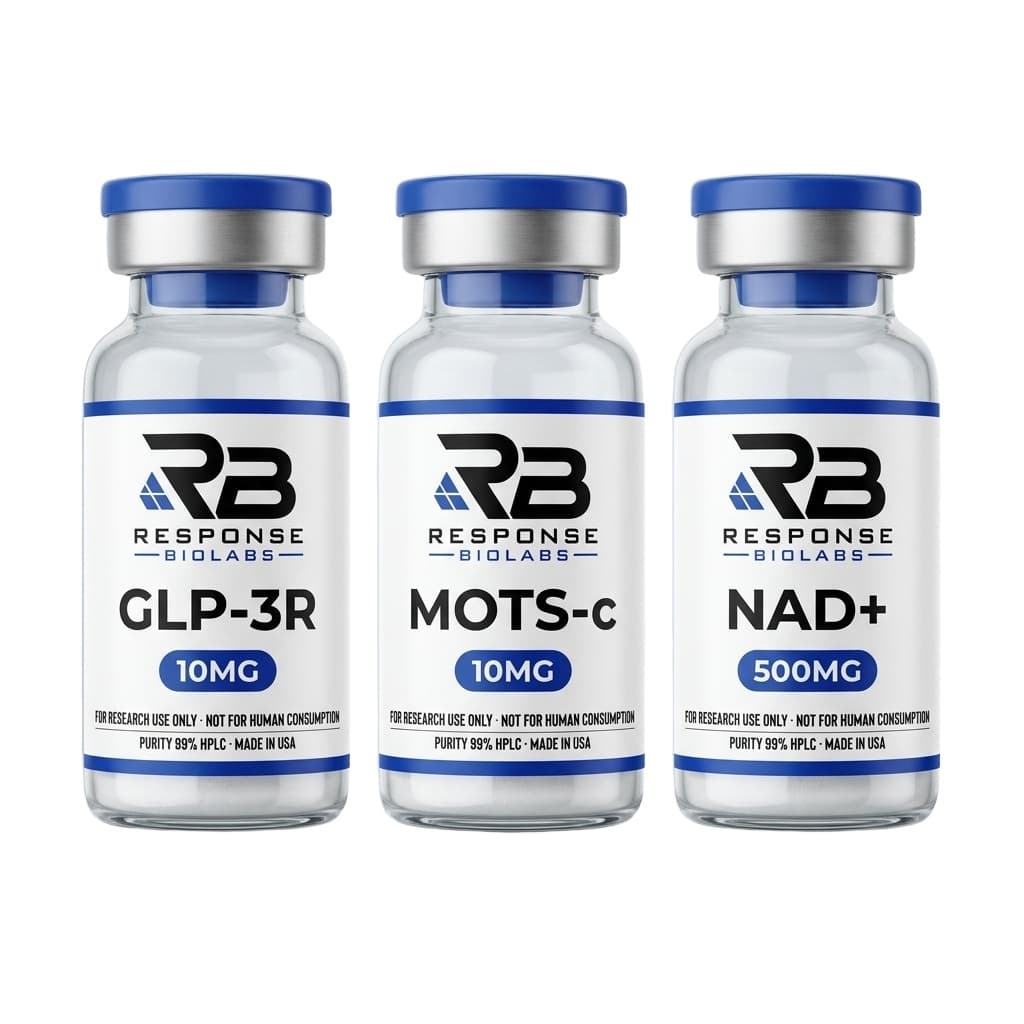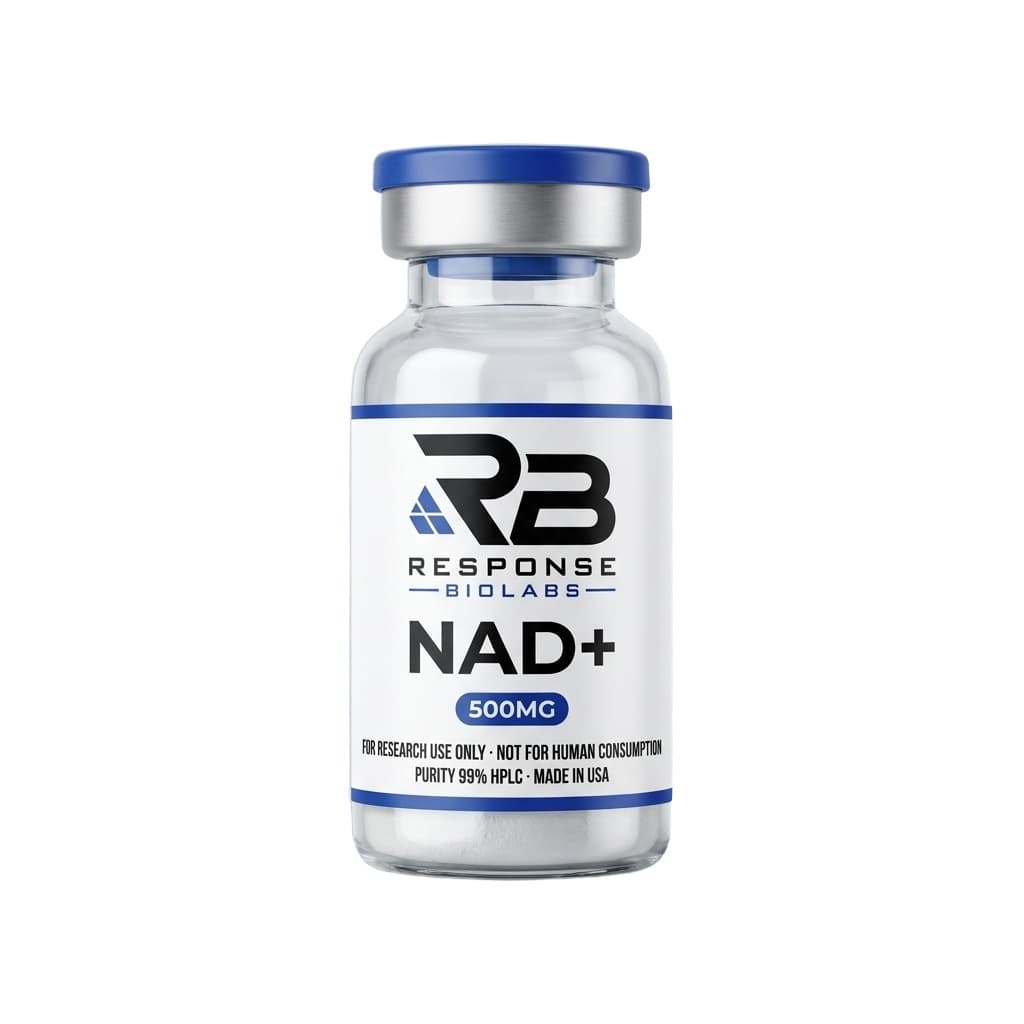
NAD+
500mg vial
Three quick questions about your research opens pricing and live availability, free and no password.
NAD+ (Nicotinamide Adenine Dinucleotide) is a dinucleotide coenzyme studied extensively in biochemistry as an electron carrier in redox reactions and as a substrate for sirtuins and PARP enzymes.
Specification
- CAS No.
- 53-84-9
- Molecular Formula
- C21H28N7O14P2
- Molecular Weight
- 664.4 g/mol
- Appearance
- White to yellow lyophilized powder
- Storage
- Refrigerate (2-8 deg C)
- Purity
- >=99%
Current lot
98.00% ± 0.18%
Purity, measured by HPLC-UV/VIS
- Lot
- Clear Cap
- Laboratory
- Vanguard Laboratory
- Reported
- 13 November 2025
- Quantity
- 454 mg against a 500 mg label
- Identity confirmed as NAD+
- Endotoxin: Pass, < 0.05 EU/mg
- Sterility: Pass, negative for growth
- Issued by an ISO 17025 accredited laboratory
Research library
Read the full NAD+ research summary
Chemistry, mechanisms under investigation, and the state of the published evidence.
For research use only. Not for human consumption. Not FDA approved.
What NAD+ is
NAD+ is a redox coenzyme and the consumed substrate of sirtuins, PARPs, and CD38, studied extensively in metabolic and aging biology.
Mechanisms under investigation
Proposed pathways from the published literature. Not established clinical effects.
- 01Serves as the two-electron hydride acceptor in dehydrogenase reactions across glycolysis, the citric acid cycle, and fatty acid oxidation, cycling between NAD+ and NADH without being consumed.
- 02Is consumed stoichiometrically by sirtuins SIRT1 through SIRT7, which cleave the nicotinamide glycosidic bond during lysine deacylation and release nicotinamide as a feedback inhibitor.
- 03Is consumed by PARP1 and PARP2 during poly-ADP-ribosylation in the DNA damage response, making PARP the largest acute NAD sink under genotoxic stress.
- 04Is hydrolyzed by the ectoenzymes CD38 and CD157, whose expression increases with age in mouse tissues and has been reported to drive age-associated NAD decline in that model.
- 05Is resynthesized primarily through the salvage pathway, where nicotinamide phosphoribosyltransferase is rate-limiting, with additional routes from nicotinic acid and de novo from tryptophan via the kynurenine pathway.
- 06Is not efficiently transported across the plasma membrane intact; extracellular NAD+ is degraded by CD38 and CD73 to nicotinamide mononucleotide and nicotinamide riboside before cellular uptake.
Where the evidence stands
The biochemistry of NAD+ is genuinely established: its structure, redox function, biosynthetic routes, and consuming enzymes are textbook material confirmed across many independent laboratories. What is not established is anything about administering NAD+ itself as an intervention. That research is dominated by rodent studies of precursors rather than NAD+ directly, and the small human trials that exist studied precursors, not NAD+.
What is established: the structure, redox chemistry, biosynthetic routes, and consuming enzymes of NAD+ are textbook biochemistry, independently confirmed across decades and thousands of laboratories. Structures of sirtuins and PARPs with bound cofactor are solved. The stoichiometric NAD requirement of the sirtuins and the role of PARP activation in acute NAD depletion are not in dispute. This is the most solidly characterized compound in this library by a wide margin.
What is reasonably well supported in animal models: NAD+ concentrations decline with age in multiple rodent tissues, CD38 upregulation contributes to that decline in mice, and administration of the precursors nicotinamide riboside and nicotinamide mononucleotide raises tissue NAD metabolites and produces metabolic changes in various rodent models. That body of work is substantial, though replication across laboratories and models has been uneven, and effect sizes vary considerably with the model used.
Common questions
What is NAD+ studied for?
NAD+ is a redox coenzyme and the consumed substrate of sirtuins, PARPs, and CD38, studied extensively in metabolic and aging biology.
Does NAD+ come with a certificate of analysis?
Yes. 1 third party certificate for NAD+ are published on this site, covering endotoxin, purity and sterility. Each one is the report as the testing laboratory issued it, not a retyped summary, and the most recent lot is 500mg · Oct 2025. Match the batch on your vial to the batch on the report.
What is the CAS number for NAD+?
53-84-9. It is printed in the specification table on this page so it can be checked against your own records before ordering.
How should NAD+ be stored?
Refrigerate (2-8 deg C) Lyophilized powder is the stable form; once reconstituted, a solution is far more fragile and should be aliquoted rather than repeatedly frozen and thawed.
What purity is NAD+?
>=99% by HPLC. The released figure for any given lot is on that lot's certificate rather than taken from this page, because purity is a property of a batch and not of a product line.
Is NAD+ intended for human use?
No. This is sold for laboratory research use only. It is not a drug, not a supplement, and not approved by the FDA for human or veterinary use. We do not provide dosing, administration, or protocol guidance, by phone, by email, or through the assistant on this site.
Is NAD+ a peptide?
No. NAD+ is a dinucleotide coenzyme, not a peptide, even though it is frequently listed alongside peptides in research catalogs. It consists of adenosine monophosphate and nicotinamide mononucleotide joined by a pyrophosphate bridge, and its handling and stability requirements differ from those of peptides.
Why does most of the research use precursors instead of NAD+ itself?
Because NAD+ is large and highly charged and is not efficiently taken up by cells intact. Extracellular NAD+ is degraded at the cell surface by CD38 and CD73 into nicotinamide mononucleotide and nicotinamide riboside, which are then transported and reassembled into NAD+ inside the cell. Study designs use precursors because that is the route the biology actually takes.
Is there human clinical data on NAD+?
Human trials in this field have studied the precursors nicotinamide riboside and nicotinamide mononucleotide, not NAD+ itself. Those trials have generally been small and short, have shown that precursors raise blood NAD metabolite levels and are tolerated over the durations studied, and have produced mixed results on functional endpoints. There is no controlled human trial evidence for NAD+ administration itself.
What is the difference between NAD+ and NADP+?
NADP+ carries an additional phosphate on the adenosine ribose and serves a different function. The NAD+ and NADH pool is kept largely oxidized to accept electrons from fuel breakdown, while the NADP+ and NADPH pool is kept largely reduced to donate electrons for biosynthesis and for regenerating the glutathione and thioredoxin systems. They are not interchangeable in assays.
How should NAD+ concentration be verified in the laboratory?
Spectrophotometrically. NADH absorbs strongly at 340 nm with an extinction coefficient of approximately 6220 per molar per centimeter while NAD+ does not, which allows direct determination of oxidation state and is the basis of coupled dehydrogenase assays. Because aqueous NAD+ loses titer over days, concentration should be measured rather than calculated from mass for any assay where cofactor level is a variable.
Why do published tissue NAD+ concentrations vary so much between papers?
Largely because of methodology. NAD+ degrades quickly during sample processing, and extraction methods differ in how well they preserve the oxidized and reduced species separately. Differences in extraction and detection between laboratories are often larger than the biological effects reported, so quantification methods should be compared before the numbers are.
References
Every citation links to the paper it names on PubMed.
- 01Imai S, Armstrong CM, Kaeberlein M, Guarente L (2000). Transcriptional silencing and longevity protein Sir2 is an NAD-dependent histone deacetylase. Nature. PMID 10693811
- 02Preiss J, Handler P (1958). Biosynthesis of diphosphopyridine nucleotide. Journal of Biological Chemistry. PMID 13563527
- 03Bieganowski P, Brenner C (2004). Discoveries of nicotinamide riboside as a nutrient and conserved NRK genes establish a Preiss-Handler independent route to NAD+ in fungi and humans. Cell. PMID 15137942
- 04Canto C, Menzies KJ, Auwerx J (2015). NAD+ metabolism and the control of energy homeostasis: a balancing act between mitochondria and the nucleus. Cell Metabolism. PMID 26118927
- 05Verdin E (2015). NAD+ in aging, metabolism, and neurodegeneration. Science. PMID 26785480
- 06Camacho-Pereira J, Tarrago MG, Chini CCS, et al. (2016). CD38 dictates age-related NAD decline and mitochondrial dysfunction through an SIRT3-dependent mechanism. Cell Metabolism. PMID 27304511
- 07Rajman L, Chwalek K, Sinclair DA (2018). Therapeutic potential of NAD-boosting molecules: the in vivo evidence. Cell Metabolism. PMID 29514064
- 08Trammell SAJ, Schmidt MS, Weidemann BJ, et al. (2016). Nicotinamide riboside is uniquely and orally bioavailable in mice and humans. Nature Communications. PMID 27721479
Related compounds