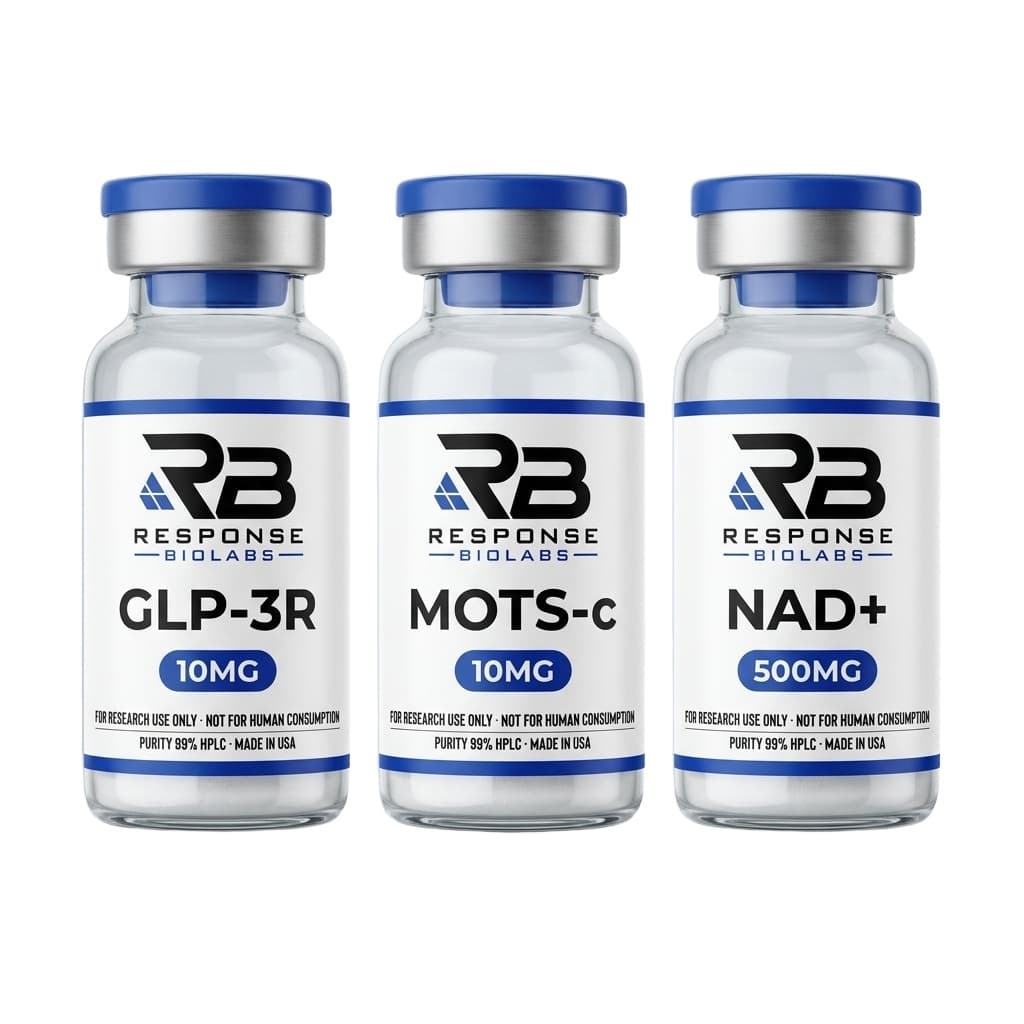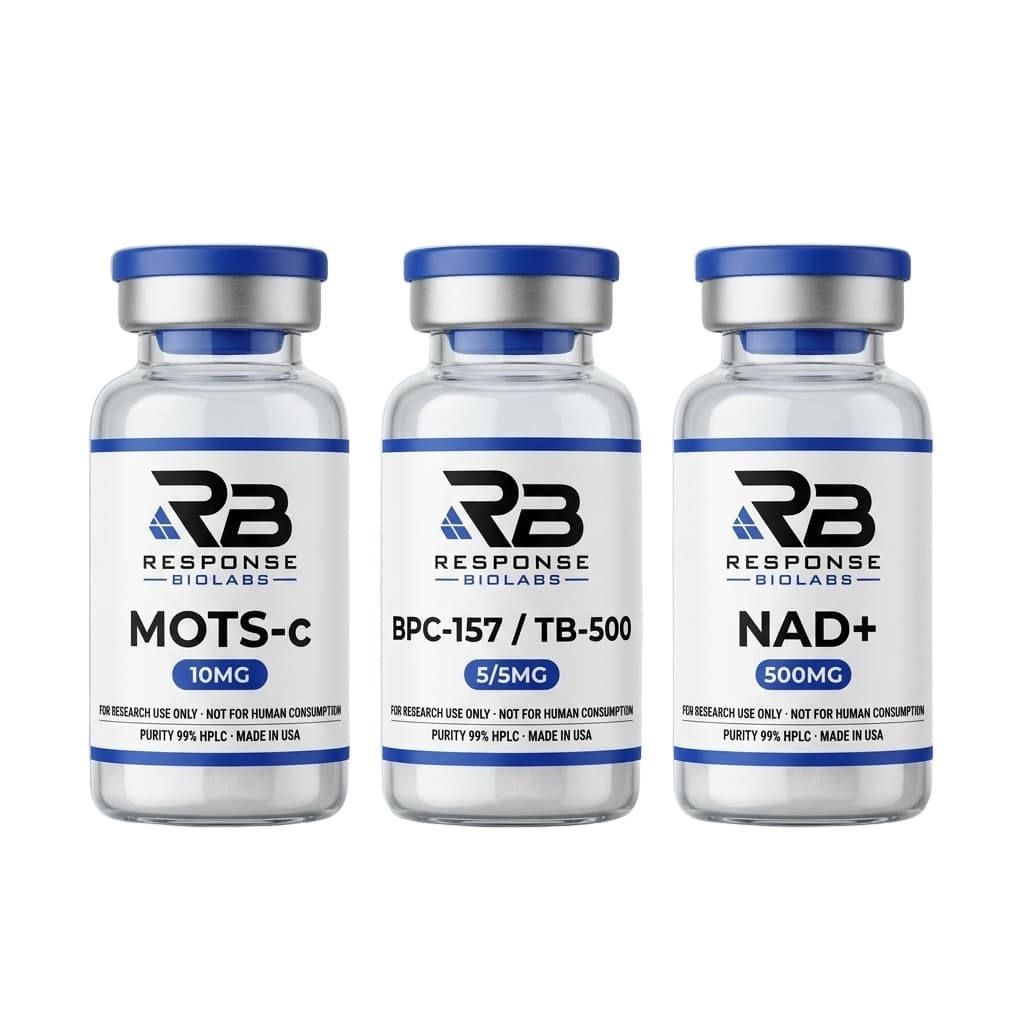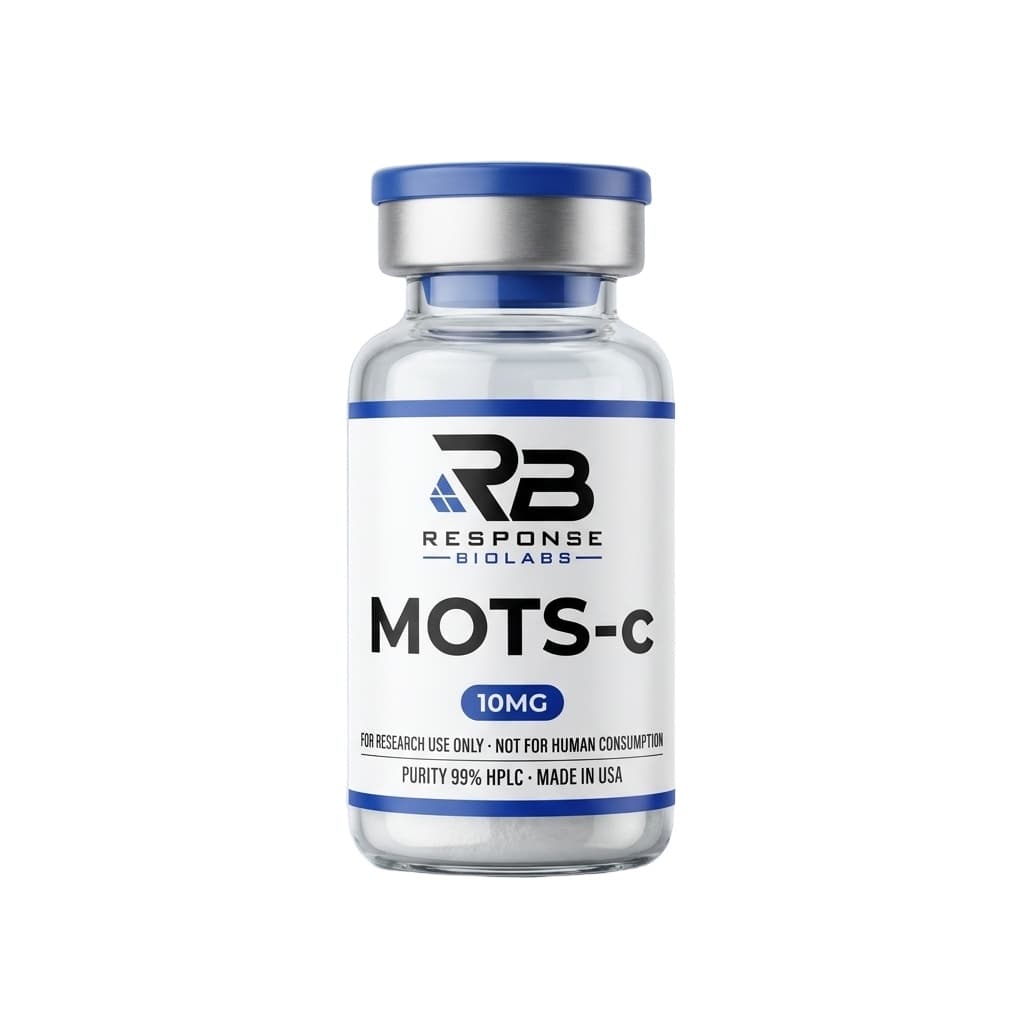
MOTS-c
10mg vial
Three quick questions about your research opens pricing and live availability, free and no password.
MOTS-c is a mitochondria-derived peptide that is investigated in preclinical research for its interactions with metabolic signaling pathways and AMPK activity.
Specification
- CAS No.
- 1627580-64-6
- Molecular Formula
- C101H152N28O22S2
- Molecular Weight
- 2288.6 g/mol
- Appearance
- White lyophilized powder
- Storage
- Refrigerate (2-8 deg C)
- Purity
- >=99%
Current lot
99.41% ± 0.18%
Purity, measured by HPLC-UV/VIS
- Lot
- Blue Cap (lab ID V251104-11 001)
- Laboratory
- Vanguard Laboratory
- Reported
- 18 November 2025
- Quantity
- 10.63 mg
- Identity confirmed as MOTS-c
- Endotoxin: PASS, < 0.05 EU/mg
- Sterility: PASS, negative for growth
- Issued by an ISO 17025 accredited laboratory
Research library
Read the full MOTS-c research summary
Chemistry, mechanisms under investigation, and the state of the published evidence.
For research use only. Not for human consumption. Not FDA approved.
What MOTS-c is
MOTS-c is a sixteen-residue mitochondria-encoded peptide studied for its interactions with the folate cycle and AMPK activation in metabolic research.
Sequence Met-Arg-Trp-Gln-Glu-Met-Gly-Tyr-Ile-Phe-Tyr-Pro-Arg-Lys-Leu-Arg (MRWQEMGYIFYPRKLR)
Mechanisms under investigation
Proposed pathways from the published literature. Not established clinical effects.
- 01Reported inhibition of the folate cycle enzyme methylenetetrahydrofolate dehydrogenase 2, interrupting de novo purine biosynthesis flux.
- 02Consequent accumulation of AICAR, an endogenous activator of AMP-activated protein kinase, producing indirect rather than direct AMPK activation.
- 03Downstream AMPK effects reported in mouse muscle include increased GLUT4 translocation and glucose uptake and increased fatty acid oxidation.
- 04Observed translocation from cytoplasm to nucleus under glucose restriction and oxidative stress, associating with chromatin at antioxidant response elements.
- 05Reported regulation of NRF2-associated stress response gene expression in concert with transcription factors including ATF1.
- 06Encoded within the mitochondrial 12S ribosomal RNA gene, making it a candidate mediator of retrograde signaling from mitochondrion to nucleus.
Where the evidence stands
The existence, sequence, and mitochondrial origin of MOTS-c are established, and human observational work has measured endogenous levels and their response to exercise. The functional and metabolic findings that drive research interest come from mouse and cell culture studies. No interventional human trial of administered MOTS-c has been published.
What is established: MOTS-c exists, its sequence is defined, and its origin in a short open reading frame within the mitochondrial 12S ribosomal RNA gene has been confirmed. It is detectable in human plasma and tissue by mass spectrometry and immunoassay. The broader category of mitochondrial-derived peptides is now accepted, with humanin and the small humanin-like peptides characterized alongside it.
What is supported in humans but only observationally: endogenous MOTS-c levels have been measured across age groups and reported to decline with age in some cohorts, and circulating levels have been reported to rise following exercise. Genetic association work has linked the m.1382A>C variant, which alters residue fourteen of the peptide, to longevity and metabolic phenotypes in specific populations. This is real human data, and it is correlational. It establishes that the peptide is present and that it varies with physiological state. It does not establish what happens when the peptide is administered.
Common questions
What is MOTS-c studied for?
MOTS-c is a sixteen-residue mitochondria-encoded peptide studied for its interactions with the folate cycle and AMPK activation in metabolic research.
Does MOTS-c come with a certificate of analysis?
Yes. 1 third party certificate for MOTS-c are published on this site, covering endotoxin, purity and sterility. Each one is the report as the testing laboratory issued it, not a retyped summary, and the most recent lot is 10mg · Nov 2025. Match the batch on your vial to the batch on the report.
What is the CAS number for MOTS-c?
1627580-64-6. It is printed in the specification table on this page so it can be checked against your own records before ordering.
How should MOTS-c be stored?
Refrigerate (2-8 deg C) Lyophilized powder is the stable form; once reconstituted, a solution is far more fragile and should be aliquoted rather than repeatedly frozen and thawed.
What purity is MOTS-c?
>=99% by HPLC. The released figure for any given lot is on that lot's certificate rather than taken from this page, because purity is a property of a batch and not of a product line.
Is MOTS-c intended for human use?
No. This is sold for laboratory research use only. It is not a drug, not a supplement, and not approved by the FDA for human or veterinary use. We do not provide dosing, administration, or protocol guidance, by phone, by email, or through the assistant on this site.
What does the name MOTS-c stand for?
Mitochondrial Open Reading Frame of the 12S ribosomal RNA Type-c. The name describes its genomic origin: a short open reading frame located within the mitochondrial 12S rRNA gene rather than in the nuclear genome.
Is there human data on MOTS-c?
There is observational human data. Endogenous MOTS-c has been measured in human plasma, reported to decline with age in some cohorts, and reported to rise following exercise, and a mitochondrial DNA variant altering the peptide has been associated with longevity in specific populations. There is no published interventional human trial of administered MOTS-c and no human pharmacokinetic or safety data.
Does MOTS-c activate AMPK directly?
Not according to the proposed mechanism. The published model is indirect: MOTS-c is reported to inhibit methylenetetrahydrofolate dehydrogenase 2 in the folate one-carbon cycle, causing accumulation of AICAR, which is itself an endogenous AMPK activator. The peptide shifts a metabolic flux rather than binding the kinase.
Why do supplier certificates list different molecular weights for MOTS-c?
The calculated free base molecular weight for MRWQEMGYIFYPRKLR is approximately 2174.6 g/mol. Higher figures on certificates typically reflect counterion content, usually acetate or trifluoroacetate retained from purification. It is the same molecule. Work from net peptide content rather than gross powder mass when concentration accuracy matters.
What is the main stability concern for this peptide?
Oxidation of its two methionine residues, at positions one and six. Methionine sulfoxide formation is accelerated by air exposure, trace transition metals in buffers, and extended time in solution, and appears in mass spectrometry as a peak sixteen mass units above the parent. Minimizing agitation, using metal-free water, and aliquoting for single use are the practical controls.
How does MOTS-c relate to humanin?
Both are mitochondrial-derived peptides, meaning both are encoded within the mitochondrial genome rather than the nuclear genome. Humanin was identified first, in 2001, from the 16S ribosomal RNA gene region; MOTS-c was reported in 2015 from the 12S region. They have different sequences, different proposed mechanisms, and separate literatures.
References
Every citation links to the paper it names on PubMed.
- 01Lee C, Zeng J, Drew BG, et al. (2015). The mitochondrial-derived peptide MOTS-c promotes metabolic homeostasis and reduces obesity and insulin resistance. Cell Metabolism. PMID 25738459
- 02Kim KH, Son JM, Benayoun BA, Lee C (2018). The mitochondrial-encoded peptide MOTS-c translocates to the nucleus to regulate nuclear gene expression in response to metabolic stress. Cell Metabolism. PMID 29983246
- 03Reynolds JC, Lai RW, Woodhead JST, et al. (2021). MOTS-c is an exercise-induced mitochondrial-encoded regulator of age-dependent physical decline and muscle homeostasis. Nature Communications. PMID 33473109
- 04Fuku N, Pareja-Galeano H, Zempo H, et al. (2015). The mitochondrial-derived peptide MOTS-c: a player in exceptional longevity?. Aging Cell. PMID 26289118
- 05Lee C, Yen K, Cohen P (2013). Humanin: a harbinger of mitochondrial-derived peptides?. Trends in Endocrinology and Metabolism. PMID 23402768
- 06Merry TL, Chan A, Woodhead JST, et al. (2020). Mitochondrial-derived peptides in energy metabolism. American Journal of Physiology: Endocrinology and Metabolism. PMID 32776825
- 07Kim SJ, Xiao J, Wan J, Cohen P, Yen K (2017). Mitochondrially derived peptides as novel regulators of metabolism. Journal of Physiology. PMID 28574175
Related compounds