
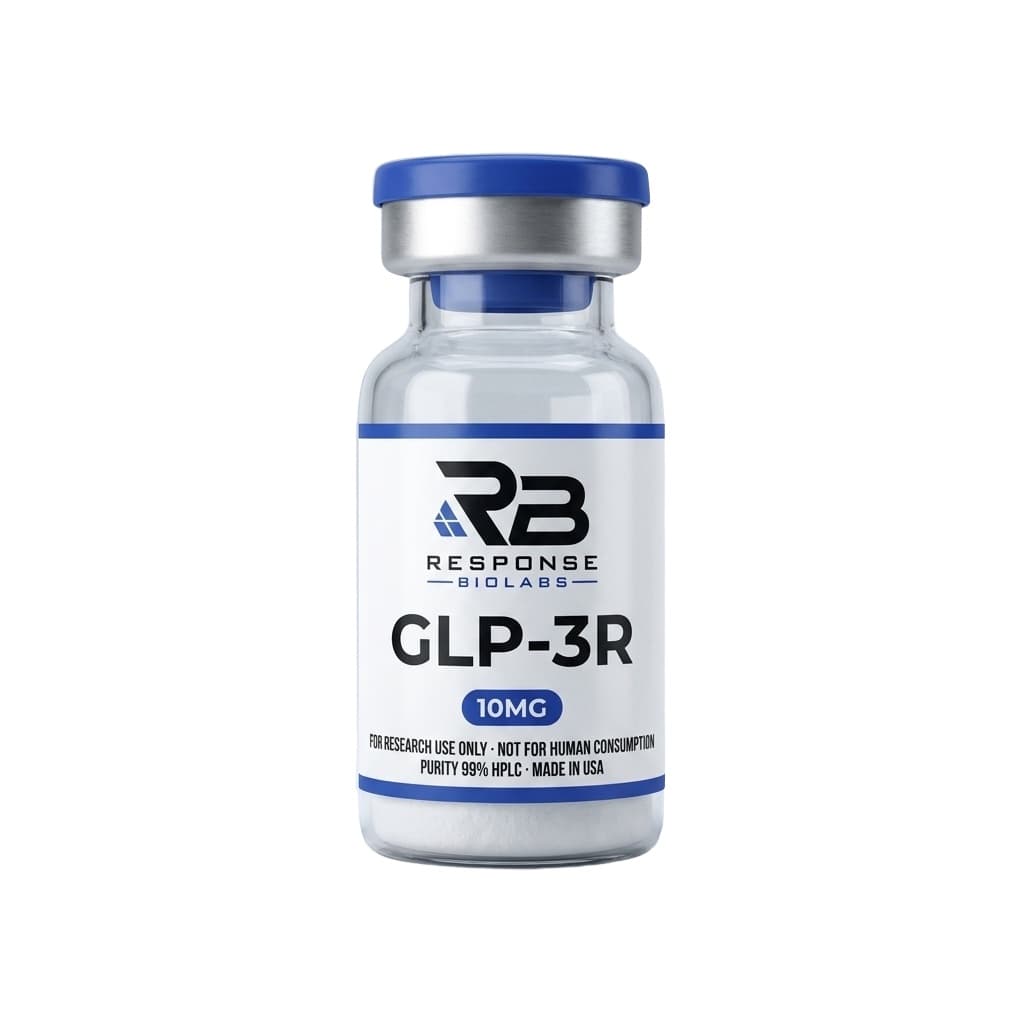
GLP-3R
10mg vial
Three quick questions about your research opens pricing and live availability, free and no password.
Specification
- Appearance
- White powder
- Storage
- Refrigerate (2-8 deg C)
- Purity
- >=99%
Current lot
>99.80% ± 0.18%
Purity, measured by HPLC-UV/VIS
- Lot
- Yellow Cap (lab ID V260112-4 001)
- Laboratory
- Vanguard Laboratory
- Reported
- 29 January 2026
- Quantity
- 11.06 mg
- Identity confirmed as GLP3-R
- Endotoxin: PASS, < 5.00 EU/mg
- Sterility: PASS, no growth detected
- Issued by an ISO 17025 accredited laboratory
Research library
Read the full GLP-3R research summary
Chemistry, mechanisms under investigation, and the state of the published evidence.
For research use only. Not for human consumption. Not FDA approved.
What GLP-3R is
GLP-3R is a supplier-designated research construct in the incretin and metabolic signaling space, with no peer-reviewed literature on the construct itself.
Mechanisms under investigation
Proposed pathways from the published literature. Not established clinical effects.
- 01The incretin receptor family it references consists of GLP1R, GIPR, and GCGR, all class B1 secretin-family G protein-coupled receptors that couple primarily to Gs.
- 02GLP-1R engagement raises intracellular cyclic AMP and potentiates glucose-stimulated insulin secretion through protein kinase A and Epac2 in a glucose-dependent manner.
- 03GIPR is expressed on beta cells and adipocytes, and both agonism and antagonism at this receptor are actively investigated in the published literature.
- 04GCGR engagement on hepatocytes drives hepatic glucose output and has been studied in the polyagonist literature for its contribution to energy expenditure.
- 05Dipeptidyl peptidase-4 inactivates native incretin peptides by cleaving after the second residue, making protease resistance the central design constraint in this class.
- 06Whether this specific construct engages any of these receptors, and at what selectivity, has not been published or independently determined.
Where the evidence stands
There is no peer-reviewed literature on this specific construct. No published receptor binding data, no pharmacokinetics, and no animal or human studies of the material itself exist. The underlying incretin receptor pharmacology is well established, but that background does not transfer to an uncharacterized blend.
What is established: incretin receptor pharmacology is a mature field. The identity, structure, and coupling of GLP1R, GIPR, and GCGR are known, including cryo-electron microscopy structures of receptor complexes. The glucose-dependence of GLP-1R-mediated insulin potentiation, the role of dipeptidyl peptidase-4 in ligand inactivation, and the physiology of the incretin effect are all supported by decades of independently replicated work in multiple species including humans.
What is established about the unimolecular polyagonist concept: published academic work has reported that single peptides engineered to engage multiple receptors in this family produce metabolic effects in rodent models that differ from single-receptor engagement, and several such molecules have progressed into formal clinical development programs with published results. Those results belong to specific, fully characterized molecules with disclosed sequences and registered trial data. They do not belong to unrelated material that shares a conceptual category.
Common questions
What is GLP-3R studied for?
GLP-3R is a supplier-designated research construct in the incretin and metabolic signaling space, with no peer-reviewed literature on the construct itself.
Does GLP-3R come with a certificate of analysis?
Yes. 10 third party certificates for GLP-3R are published on this site, covering endotoxin, purity and sterility. Each one is the report as the testing laboratory issued it, not a retyped summary, and the most recent lot is 5mg · Jan 2026. Match the batch on your vial to the batch on the report.
How should GLP-3R be stored?
Refrigerate (2-8 deg C) Lyophilized powder is the stable form; once reconstituted, a solution is far more fragile and should be aliquoted rather than repeatedly frozen and thawed.
What purity is GLP-3R?
>=99% by HPLC. The released figure for any given lot is on that lot's certificate rather than taken from this page, because purity is a property of a batch and not of a product line.
Is GLP-3R intended for human use?
No. This is sold for laboratory research use only. It is not a drug, not a supplement, and not approved by the FDA for human or veterinary use. We do not provide dosing, administration, or protocol guidance, by phone, by email, or through the assistant on this site.
Is GLP-3R a real receptor?
No. There is no GLP-3 receptor in human physiology, no corresponding gene, and no entry in IUPHAR receptor nomenclature. The recognized family is GLP1R, GIPR, and GCGR. GLP-3R is a supplier designation for a research construct, and the numeral references a multi-receptor design concept rather than a receptor subtype.
Why are the chemistry fields empty for this entry?
Because the composition is proprietary and undisclosed, there is no published sequence, molecular formula, molecular weight, or CAS number for this designation. Publishing invented values would be worse than publishing none. Researchers should obtain lot-specific analytical data rather than relying on catalog specifications.
Is there any published research on GLP-3R?
None on this construct. No receptor binding data, no functional assay data, no pharmacokinetics, no animal studies, and no human data have been published for it. The peer-reviewed literature that exists concerns the incretin receptor family generally and specific, fully characterized molecules that are unrelated to this material.
Can findings from published multi-receptor peptides be applied to this construct?
No, other than as general background on receptor biology. Published polyagonist studies describe defined molecules with disclosed sequences and measured receptor affinities. Transferring those findings assumes an equivalence that has never been demonstrated for a construct of undisclosed composition.
What analytical documentation should be requested for a blended construct?
A lot-specific certificate of analysis, a mass spectrometry profile identifying every component present rather than confirming a single expected mass, a reversed-phase HPLC trace showing relative abundance of each species, and a net peptide content figure accounting for water and counterion. Third-party testing on the received lot carries the most weight.
Is GLP-3R approved for any use?
No. It is not an approved drug in any jurisdiction, has no published clinical development program, and is supplied for laboratory research use only. It is not equivalent to any commercial pharmaceutical product.
References
Every citation links to the paper it names on PubMed.
- 01Elrick H, Stimmler L, Hlad CJ, Arai Y (1964). Plasma insulin response to oral and intravenous glucose administration. Journal of Clinical Endocrinology and Metabolism. PMID 14228531
- 02Brown JC, Dryburgh JR (1971). A gastric inhibitory polypeptide II: the complete amino acid sequence. Canadian Journal of Biochemistry. PMID 5120249
- 03Mojsov S, Heinrich G, Wilson IB, et al. (1986). Preproglucagon gene expression in pancreas and intestine diversifies at the level of post-translational processing. Journal of Biological Chemistry. PMID 3528148
- 04Mentlein R, Gallwitz B, Schmidt WE (1993). Dipeptidyl-peptidase IV hydrolyses gastric inhibitory polypeptide, glucagon-like peptide-1(7-36)amide, peptide histidine methionine and is responsible for their degradation in human serum. European Journal of Biochemistry. PMID 8100523
- 05Baggio LL, Drucker DJ (2007). Biology of incretins: GLP-1 and GIP. Gastroenterology. PMID 17498508
- 06Campbell JE, Drucker DJ (2013). Pharmacology, physiology, and mechanisms of incretin hormone action. Cell Metabolism. PMID 23684623
- 07Finan B, Yang B, Ottaway N, et al. (2015). A rationally designed monomeric peptide triagonist corrects obesity and diabetes in rodents. Nature Medicine. PMID 25485909
- 08Muller TD, Finan B, Bloom SR, et al. (2019). Glucagon-like peptide 1 (GLP-1). Molecular Metabolism. PMID 31767182